
Published by Splash247
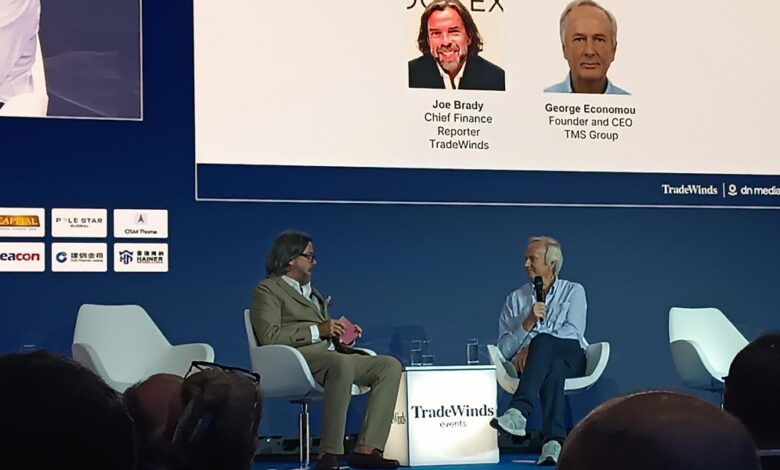
George Economou sat down at TradeWinds Shipowners Forum Greece at Posidonia in Athens yesterday with the newspaper’s US correspondent Joe Brady for a rare extended conversation about how he built one of shipping’s most formidable private empires — and the bond workout, the stock market frenzy, the $2bn drilling debacle and the activist campaigns that marked the journey.
Born in Athens in 1953 into a family with no shipping connections — his father sold paper products — Economou said the choice of career was driven by simple observation.
“The only people that had a decent salary were people working in shipping,” he said.
From that starting point he pursued a notably rigorous academic path: two bachelor’s degrees, a master’s in naval architectural engineering and an MBA. He spent 10 years working in Greek shipping companies, the last eight in New York, before making his move.
“I decided to sell my apartment, come back to Greece,” he said. “I wouldn’t have liked to leave the US, but I couldn’t afford both to stay there and start my business.”
With an old classmate, he started with $800,000 and two ships. From that point, leverage and the capital markets did the rest.
The decision to turn to US capital markets early was deliberate and rooted in ambition. Economou and his partner, Petros Pappas took DryShips to listing — the first dry bulk company to do so at a time when American investors had little concept of what shipping meant beyond UPS and FedEx. “If you said the word shipping, they would think of UPS, DHL or the IRS services,” he recalled.
Before that, there was the bond workout. In early 1998, Economou raised debt through a bond issue — wrong timing, as the Asian financial crisis hit immediately. He restructured it himself, without a bank or an adviser, facing four lawyers on the other side. He eventually recovered his fleet at 37 cents on the dollar. “I went to my lawyers — they were laughing,” he said of the approach he took to working out the deal. The experience, he suggested, taught him more about capital markets than any formal instruction could.
The DryShips IPO in 2005 became the defining chapter of his public market career. The stock priced at $18 and by 2007 had reached $131 a share. At its peak, daily trading volume exceeded $1bn — more than Google on the same day. He was locked in and could not sell.
The drilling venture that followed consumed those gains and more. Economou built Ocean Rig into a major offshore drilling company through a hostile takeover in Norway, only to see the business destroyed when oil prices collapsed. Total investment was around $9bn, debt of $6.5bn raised. “All in all, it was about $2bn when the business was lost,” he said, adding drily that offshore drilling had proved “a business that is worse than shipping.”
The DryShips share dilution controversy of 2016 still draws questions. He was unsparing in his own assessment but firm on the distinction he draws. “It was either the company survives or it goes under, so I have to keep on raising money. It’s very different doing something to save your company that is legal versus just doing something to create an opportunity to take money.”
Since taking DryShips private in 2019, Economou has operated contentedly away from public markets while periodically taking activist positions in listed shipping companies. He waged a proxy campaign against Genco — pulling back at the 11th hour with a profitable exit — pursued two Palios family companies with mixed results, and lost a Marshall Islands court case over standing. On the current Diana-Genco standoff he offered this prediction: “Diana pays more than Genco would sell, but they need more than what they offered.”
At 73, he shows no sign of slowing. Asked about advice for those starting out, his answer was characteristically direct. “If you love it and you’re willing to work, focus and try to understand how it functions. There’s a lot of noise, whether it’s fuels, IMO, this and the other — just try to separate what you need to focus on, work hard, and you will succeed.”
Whether shipping remains the vehicle for the next generation of the Economou family is, he said, not his decision. “It’s for the next generation because they’re already in there.” As for the industry itself: “Shipping is really a place where you start to make money.” Whether you stay is another question entirely.