
Published by automotivelogistics.media
GM’s plan to build the Aveo and Groove in Ramos Arizpe signals a broader rethink of localisation, trade exposure and supply chain resilience across North America’s automotive industrySource: GM
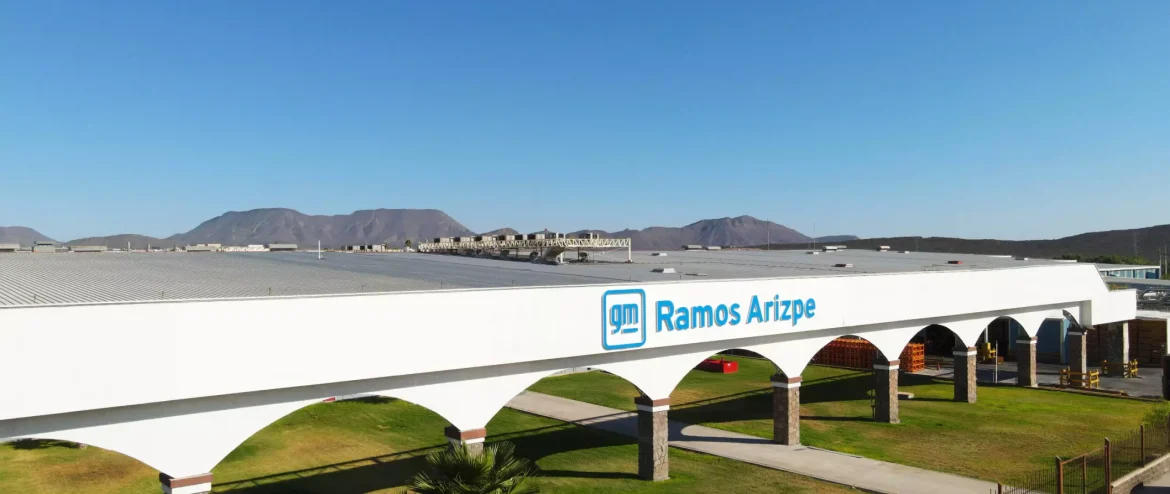
General Motors has announced it will begin assembling the Chevrolet Aveo and Chevrolet Groove at its Ramos Arizpe complex in the state of Coahuila from 2027, supplying the domestic market with two models it currently imports from China.
The plan was announced on May 19 at GM’s Toluca complex, west of Mexico City, at an event headed by President Claudia Sheinbaum and attended by Economy Minister Marcelo Ebrard. GM said it forms part of the $1 billion investment the company announced for its Mexican operations in January. Production is due to start with the Groove in 2027, followed by the Aveo, with GM targeting an annual capacity of around 80,000 units by 2030.
“It is a project conceived in Mexico, for Mexico,” said Paco Garza, president and director general of GM de México, Central America and the Caribbean, describing it as a way to strengthen domestic industry, use installed capacity and reduce reliance on imports. GM said it would produce the vehicle programmes at its existing Ramos Arizpe complex.
GM said the project is aligned with the federal government’s “Plan México,” which targets a 10% increase in domestic vehicle production by 2030. Ebrard said the 80,000 units concerned are currently imported from Asia and described the project as import substitution that would progressively raise the share of Mexican-made parts and components, as reported by El Financiero and Infobae.
Mexico is an established part of GM’s supply base, and a significant supplier region more broadly. Speaking at the Automotive Logistics & Supply Chain Mexico conference last year, Mónica García, GM’s director of global purchasing and supply chain in Mexico, said the country offers “a strong foundation.” She said GM has around 650 tier-one suppliers in Mexico, and noted that Mexico is the second-largest source of auto parts globally, creating opportunities to strengthen the network.
In a Red Sofa interview with Automotive Logistics, García also said that “nearshoring and localisation in Mexico has significantly reshaped the supplier landscape,” describing Mexico as a “strategic anchor” in such strategies. She added that GM had adapted its sourcing strategy around greater flexibility and agility.
Assembling models previously built in another region would nonetheless require further adaptations to the supply chain.
Erick Reynoso Sierra, director of operations, supply chain management in Mexico at Penske Logistics said the move pointed to a wider trend. “This announcement reinforces the shift toward greater local integration in the automotive supply chain,” he wrote in a post on LinkedIn in response to GM’s announcement. “For logistics, it means planning ahead for capacity, synchronisation, and end-to-end visibility to support future volumes with resilience.”
Imports from China
Both the Aveo and Groove are currently imported from China, where they are assembled by GM’s SAIC-GM-Wuling joint venture. As of early 2026, the joint venture ships an estimated 130,000 China-built Chevrolets a year to Mexico, including the Aveo, Groove and Tornado van, according to GM Authority. Mexico was the single largest destination for Chinese vehicle exports in 2025, taking 625,187 units according to China Passenger Car Association data reported by Automotive Logistics.
The two models rank among GM’s highest-volume nameplates in Mexico. The Aveo was the country’s second best-selling model over January to April 2026, with 23,726 units, while the Groove recorded 6,319, according to INEGI data reported by Mexico Business. The same report, which did not specify a period, cited an INEGI breakdown of close to 200,000 GM vehicles sold in Mexico by country of manufacture: 64% made in China, 15.6% in Brazil, 11.3% in Mexico, 7.8% in the US and 1.3% in South Korea.
Tariff changes on both sides of the border
The announcement follows tariff changes affecting GM’s trade flows in both directions. From January 1, 2026, Mexico raised its duty on passenger vehicles imported from countries without a free trade agreement – among them China and India – to 50%, from 20%, as Automotive Logistics reported. The rate is the maximum Mexico can apply under its WTO bound tariff for passenger cars, and applies to finished vehicles imported from China.
Separately, a US Section 232 tariff of 25% applies to imported vehicles from Mexico to the US, with an exemption for USMCA-qualifying content. The Mexican automotive sector faces further uncertainty as the US, Mexico and Canada are set to review the USMCA trade agreements, with the first joint review due to open on July 1.
GM has already been adapting its production footprint in North America in response both to tariffs and to market changes. Since 2025, GM has said it would invest more than $6 billion in its US plants, which includes moving assembly of the petrol Chevrolet Blazer and Equinox out of Mexico from 2027, as Automotive Logistics reported. The US-bound Blazer is currently built at Ramos Arizpe. The plant moved to single-shift operation on some lines in January, a change GM linked to aligning EV output with demand, as the Mexican production centre produces electric versions of models including the Equinox and Blazer.