
Published by Seatrade-Maritime
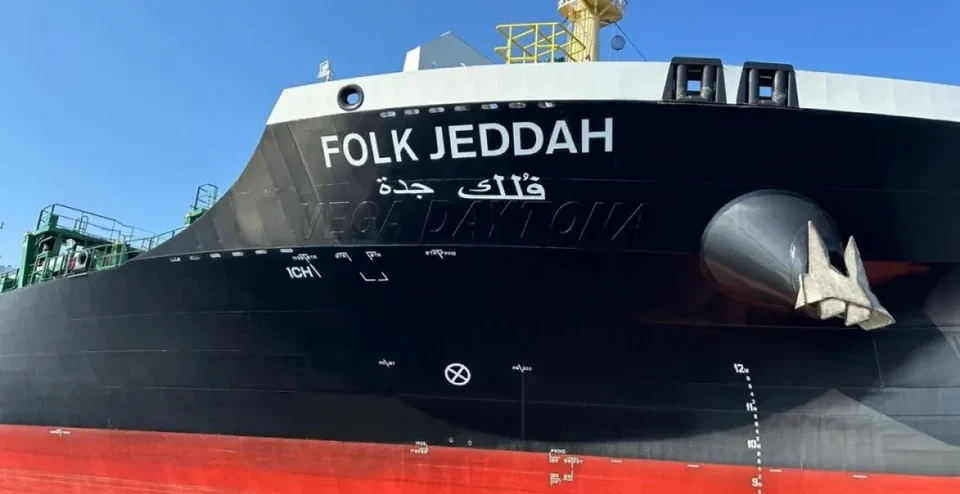
Since its launch in early 2024, Folk Maritime has not had the easiest market conditions in which to execute its initial growth plans as a feeder and regional container line based in the Middle East.
Launching soon after the container majors rerouted their ships around the Cape of Good Hope to avoid the Red Sea and the Houthi threat off Yemen, the company was two years old when war in the Middle East brought the closure of the Strait of Hormuz and further fundamental disruption to supply chains.
Speaking on the Seatrade Maritime News Podcast, Folk Maritime CEO Poul Hestbaek said that the company was fortunate enough that its ships were not in the Gulf when hostilities broke out, and its operations have since adapted to keep the cargo flowing.
“Before the 28th of February, we had access to two services from India into the Gulf all the way up to Iraq and Saudi. Those services were terminated when the state of Hormuz was closed, but, our two vessels that we operate in that trade corridor were outside. We started employing them from India, from Oman into the Red Sea to cater for predominantly local cargo from India that used to go via the Gulf into Damam and further into the hinterland of Saudi.”
That cargo now moves through Jeddah into Saudi Arabia and into Bahrain, Qatar, and Kuwait, which have become landlocked by the closure of the Strait of Hormuz.
The challenges caused by disruption to Middle East supply chains have evolved over the weeks since the conflict began, said Hestbaek.
“The most difficult part was that there was no lack of visibility. We did not know what would be the reality tomorrow. There was a lot of global cargo that got stranded on vessels initially, where the shipping lines took a wait and see approach.”
When the lines all realised that the conflict would not be over quickly, ships rushed to discharge their cargo at any port along the Indian Ocean rim, leaving the cargo until the consignee decided to move it, either waiting for the Guld to reopen, or committing to the more expensive and slower route via Jeddah. Those volumes of local and transhipment cargo have now stabilised.
“Secondly, what happened was that the cost for bunkers just went through the roof. In bunkering, we usually bunker in Jeddah, and at times the prices were triple what was normal before the Strait of Hormuz closed down. So, on the cost side, it has been dramatic,” said Hesbaek.
Now, supply chains are seeing a similar situation to the aftermath of the closure of the Bab al-Mandeb Strait — congestion. “We have waiting time for berthing in several of the ports in the Red Sea area, and that, of course, is adding more cost and bringing less efficiency into the calculation,” said Hestbaek.
The situation in the Middle East has affected the Folk Maritime’s fleet strategy and slowed its network growth.
“We had the ambitions to build up our fleet of our own container vessels slightly faster than what we’re seeing right now. Perhaps partly because of the different crises around the world, it has been a very tight supply and demand when it comes to both chartering and also acquisition of second-hand tonnage,” said Hestbaek.
The tight market has pushed up the price and also limited the visibility on the viability of vessels in the market, making acquisition decisions more difficult, but the company is maintaining stable growth despite the challenges.
“This year we hope to grow plus 30-35% so we are very strong still, but we have not been able to expand our network as we would have liked. That is probably going to be pushed into 2027, but we have had a chance to optimise and become leaner and fitter, and we have been able to stay very agile in the situation that we’re in the middle of right now,” said Hestbaek.
One threat to tight supply and demand in the container sector is any potential re-opening of the Red Sea, which would free up ship capacity as vessels return to the shorter Asia-Europe route via Suez. Hestbaek believes any such change will be felt differently by mainline container lines and regional carriers.
“There’s always an impact, but it will be different… I see that there is a focus towards near-shoring, and particularly there is a focus to friend-shoring. You want to make sure that you source your goods from a friend that is not going to stab you in next year or a week from now,” said Hestbaek.
Regional customers also need a different level of service, Hestbaek believes, and as larger lines move to greater automation and self-service, they will have more difficulty serving regional customers left behind by technological advances.
“They will, of course, eventually come on that journey, but it’s going to take time. My belief is that the combination of this, more near-shoring, friend-shoring will actually cement our position and growth in the regional trades.
“When it comes to the Middle East, I believe that we will play an increasing role. We will continue to be both a feed operator and a regional container line, but I would predict that our regional container line share will quickly become the main part of our business,” said Hestbaek.
To listen to the full podcast episode, including Folk Maritime’s plans for newbuild vessels in the player below